
4 Sep – 7 Nov 2026

The imprint is among the oldest signs of human culture. It embodies a fundamental philosophical paradox: it marks a presence that, in the very same moment, has passed into absence. Physical contact leaves a trace, holding the past within the present. Yet in an age shaped by digital and hybrid processes, the imprint is no longer simply a record of what has been. Instead, the trace of the past can become a template for what is yet to come. It becomes a dynamic process in which material, technology, chance, and perception continuously shape and transform one another.

Cathrin Hoffmann

Cathrin Hoffmann (* 1984) is a German-Iranian artist whose artistic practice spans across painting, sculpture, and installation. She investigates what it means to be human in the Technocene, an era defined by rapid technological acceleration, digital immersion, and deep planetary crisis. Central to her work is the question: What will become of humanity if we replace the physical body with a digital existence? And how important is the awareness of life for developing a sustainable relationship with the world?

Further Information

About the exhibition

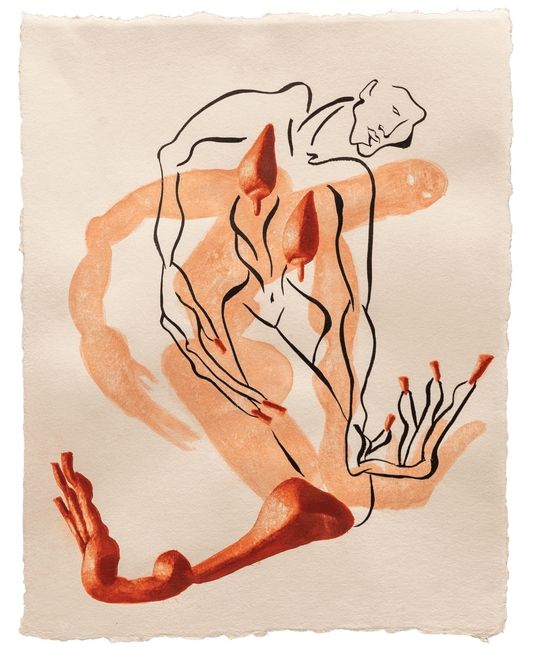
The works in this exhibition emerge from precisely this interplay between analog materiality, digital processes, and chance. Their making follows a hybrid feedback loop. It begins with monotype: wet layers of paint or ink are pressed together and pulled apart, producing forms that can never be entirely controlled. The physical properties of the material generate veins, textures, distortions, and unexpected structures. Through processes related to decalcomania, dense organic forms emerge—ambiguous shapes that invite the eye to search for something recognisable within them.

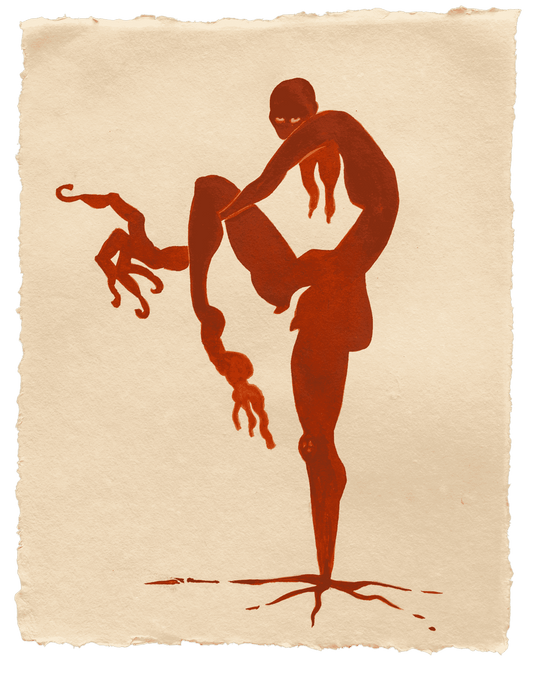
Each iteration carries traces of what came before while opening up new possibilities. The resulting figures appear simultaneously familiar and strange. Elongated limbs, masks, faces, hands, and fragmented bodies emerge from surfaces that retain the irregularity of their original material traces. In works such as Simulateness (2026) multiple bodies coexist in an ambiguous space, their elongated forms intersecting and drifting between presence and absence. In Marks of Matter (2026), the body itself appears almost geological: its dark, cracked surface seems to carry the memory of a process of formation, as if the figure were simultaneously emerging from and dissolving back into matter.

The exhibition space itself becomes part of this transformation. Where two walls meet, forming a spatial fold, the folding of the original paper is echoed in the architecture. With Blot Looking Back (2026), a central, almost symmetrical figure extends across the corner, touching both surfaces. It is not simply an image placed within the room, but a form that seems to have emerged through pressure, reflection, repetition, and spatial transfer.

Here, subject and object, idea and material, do not exist independently. They are constituted through the process itself. Every thought, every measurement, every technological intervention leaves a trace. We cannot not leave an imprint.

Through symmetry, mirroring, cutting, and the modelling of eyes and mask-like structures, the accidental blot gradually develops an identity. What began as an indeterminate mark becomes a figure—and eventually a counterpart. The work no longer functions as a passive image of something that has already happened. It becomes an active presence, capable of confronting the viewer.

This exhibition marks the moment when the trace becomes a gaze. But this is not a conclusion. The gaze opens another loop: between seeing and being seen, between projection and recognition, between matter and imagination. The work looks back, and in doing so, asks us to look again.

At this stage, looking becomes part of the making. What begins as an accidental trace gradually acquires the potential to become a body, a face, a mask, or an unfamiliar creature. The works hover between abstraction and figuration, between something that has merely left a mark and something that seems to look back.

The analog traces are then digitised and transformed within virtual space, where they are developed into a three-dimensional body. From there, they return to the physical world in another act of translation. Enlarged and layered, the forms are transferred onto paper and further developed with ink and soft pastels. The process is therefore not linear but recursive: analog matter becomes digital information and returns as a new physical form.

About Cathrin Hoffmann

With her distinctive abstract portrayal of the human form, which appears both mechanical and geometric as well as fluid and grotesquely distorted, she evokes movements from the modern era. However, she reexamines problematic aspects of that time—such as inadequate gender representation, detachment from social issues, and excessive fascination with technology and its political repercussions—and recontextualizes them with relevant perspectives on the pressing issues of the 21st century. Through a practice that unites the dualism of virtuality and reality, she dissolves the boundaries between classical painting and sculpture. Her works are characterized by blurred gradients and smooth surfaces derived from digital software, as well as dynamic brushstrokes, rough textures, and unconventional materials that create a physical presence and an immediate emotional resonance.

Since 2019, the artist has built a strong international presence through exhibitions, art fairs, and residencies. Early milestones include Virgula Divina (2019, Setareh Gallery, Düsseldorf) and group exhibitions in New York and at Art Basel Miami Beach. From 2020 onward, the practice gained momentum with solo exhibitions such as IT STILL SMELLS OF NOTHING (Public Gallery, London) and Somewhere In Between (Duve Berlin), alongside numerous international group shows. In 2021, key highlights included participation in Frieze London with Galerie Tanja Wagner and the solo exhibition The Future is Beautiful in Berlin, as well as a residency at Palazzo Monti in Brescia.

The years 2022–2023 further expanded the artist’s global reach, with solo exhibitions in Los Angeles and London, and participation in The Armory Show in New York, complemented by group exhibitions across Europe, Asia, and South America. A major institutional highlight followed in 2025 with Hardest Kinds of Soft at Kunsthalle Giessen. In 2026, upcoming solo exhibitions at Public Gallery, London, and Kunstverein Bamberg mark the next key steps, alongside participation in international group shows. The residency at the International Studio & Curatorial Program (ISCP) in New York (2026/27) represents another significant milestone.

The artist’s work is held in prominent international collections across the USA, China, Australia, Brazil, and Germany.

Artist's Bio

*1984 in Germany

lives and works in Berlin


Solo Shows

2026
Sill, Public Gallery, London, UK

Kunstverein Bamberg, Bamberg, Germany (forthcoming)

2025
Hardest Kinds of Soft, Kunsthalle Giessen, Gießen, Germany

2023
The Armory Show, Public Gallery, New York City, USA

2022
Human Hand for Scale, Nicodim Gallery, Los Angeles, USA

Probably Outside, Public Gallery, London, UK​

2021
Frieze London, Galerie Tanja Wagner, London, UK

The Future is Beautiful, Galerie Tanja Wagner, Berlin, Germany

2020
IT STILL SMELLS OF NOTHING, Public Gallery, London, UK

Somewhere In Between, Duve Berlin, Berlin, Germany

2019
Virgula Divina, Setareh Gallery, Düsseldorf, Germany


Selected group exhibitions

2026
Progress Is Not A Straight Line, IOMO Gallery, Bukarest, Romania

2025
WE. The Body as Sign, Kunstmuseum Mülheim, Mülheim a. d. Ruhr, Germany

MAXIMAL – Remise im Wrangelkiez, Berlin Art Week, Berlin, germany

Berliner Realistinnen, Haus am Lützowplatz, Berlin, Germany

Crooked Smile, Hope 93 Gallery, London, UK

2024​
Indiscret, Ventana/Passage Gallery, Berlin, Germany

Apple of Discord, Louise Alexander Gallery, Porto Cervo, Sardinia

There Is Something Odd..., Christine König Galerie, Vienna, Austria

C​reatures & Masks, Fabian Lang Galerie, Zurich, Switzerland

​2023
Now, Museu Inimá de Paula, Belo Horizonte, Brazil

We Shall Be Monsters, Petra Martinetz Galerie, Cologne, Germany

X Pink 101, X Museum, Beijing, China

Short-term pleasure, Long-term pain, Public Gallery, London UK​

2022
TRONIES, Christine König Galerie, Wien, Austria

Disembodied, Nicodim Gallery, Bucharest, Romania

2021
Saltro in Altro, Palazzo Monti, Brescia, Italy

Stockholm Sessions, Carl Kostyál, Stockholm, Sweden

The Artist is Online, König Galerie, Berlin, Germany

2020
Ein Museum Auf Probe, Villa Merkel, Esslingen, Germany

Transatlantico, Mana Contemporary, Jersey City, NJ, USA

Layers & Tracks, Galerie Ron Mandos, Amsterdam, The Netherlands

Everyday is Sunday, UTA Artist Space, Beverly Hills, CA, USA

DECADE, Marian Cramer Projects, Amsterdam, The Netherlands

Second Smile, The Hole, New York, NY, USA

2019

Juxtapoz at 25: In Black and White, Art Basel, Miami Beach, FL, USA

Too Many I In Digital, Marian Cramer Projects, Amsterdam, The Netherlands

Post Digital Pop, The Garage Amsterdam, Amsterdam, The Netherlands

Post Analog Studio, The Hole, New York, NY, USA

Selected residencies

2026/27
International Studio & Curatorial Program (ISCP), New York, USA

2021
Palazzo Monti, Brescia, Italy

2019
PLOP, London, UK

Selected public collections

​Green Family Art Foundation, Dallas Texas, USA

Longlati Foundation, Shanghai, China

Buxton Contemporary, Melbourne, Australia

X Museum, Beijing, China

Museu Inimá de Paula, Belo Horizonte, Brazil

Fundación MEDIANOCHE0, Granada, Spain

Xiao Museum, Rizhao, China

Collection Born, Munich, Germany

The Olbricht Collection, Ruhrgebiet, Germany

1 of 3

Feel free to contact us if you need more information or photos!